Facilitating Blameless, Globally Distributed Retrospectives
Your distributed team just wrapped a major project, and you’re dreading the retrospective meeting. You know that scheduling a synchronous call across five time zones will exhaust half your team, that your quieter team members won’t speak up in front of the group, and that someone will inevitably blame someone else for the delays. According to research from Cornell University, psychological safety is a top predictor of team learning and performance, yet 54 percent of employees report feeling unsafe speaking candidly at work (Cornell University, 2022). Remote retrospectives often amplify this problem: they’re harder to schedule, easier to dismiss, and more vulnerable to groupthink and blame culture. Here’s how you can transform your project post-mortems from demoralizing checkbox exercises into honest, inclusive conversations that actually improve your remote systems with practical, tested strategies.
Why Traditional Post-Mortems Fail Remotely
Synchronous retrospectives sound straightforward: gather the team, discuss what went well and what didn’t, commit to improvements. But remote execution exposes three fatal weaknesses that derail even well-intentioned facilitators. First, time zone fatigue skews participation. When your retrospective runs at 7 a.m. for some team members and 5 p.m. for others, you’re not getting equal input. The morning people are groggy and less engaged, while the evening people are mentally checked out. Research from the American Psychological Association found that fatigue reduces cognitive function and increases defensive behavior in group settings (American Psychological Association, 2023). Second, cultural hesitancy silences voices. Distributed teams often span cultures with different norms around authority, conflict, and direct feedback. In many Asian and Latin American cultures, challenging senior team members in a live setting feels inappropriate, even anonymously in a chat. Third, the loudest voice problem magnifies these issues: extroverted team members dominate the conversation, introverted and asynchronous contributors fade into the background, and you leave the meeting convinced you’ve heard all perspectives when you’ve actually heard from maybe 40 percent of your team.
Start with Asynchronous Brainstorming Using Anonymous Digital Whiteboards
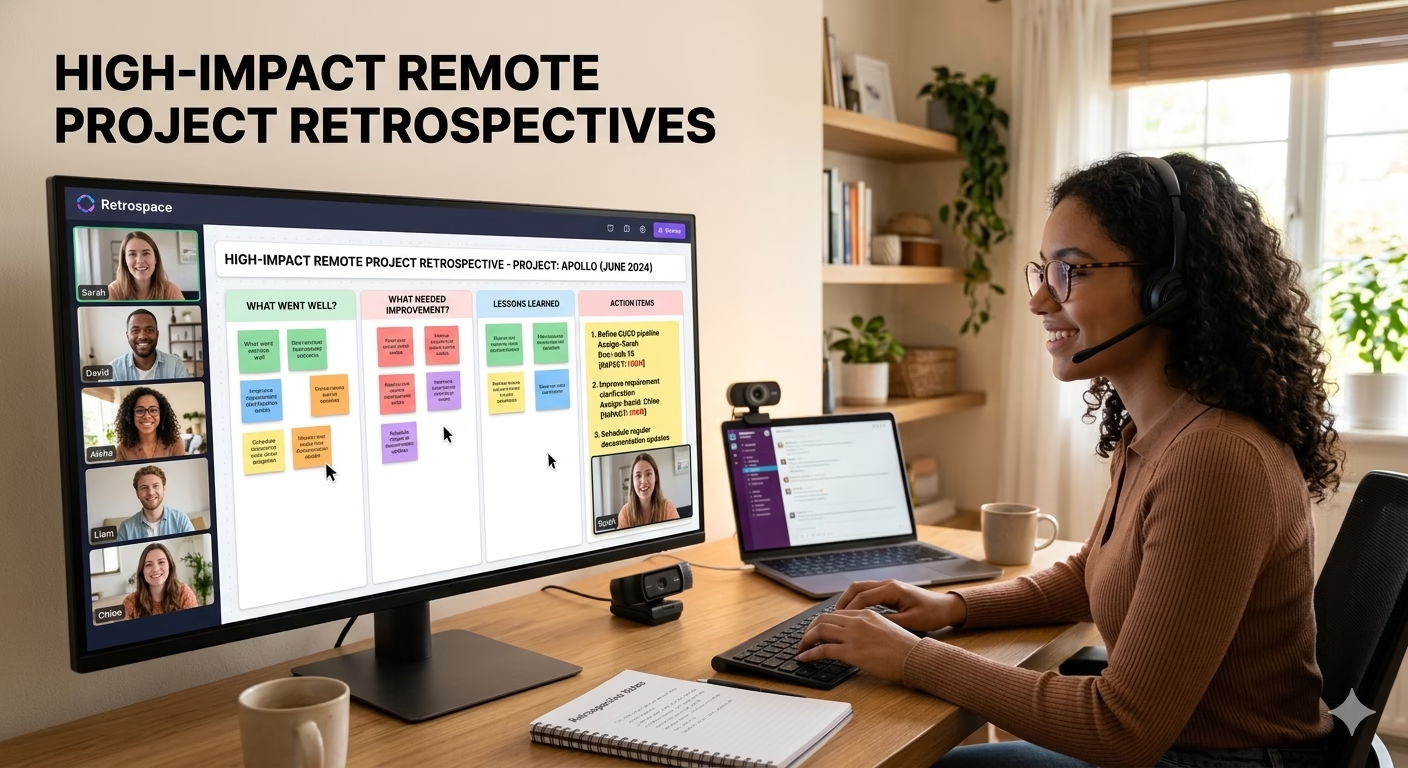
Replace your initial brainstorming phase with a 48-hour asynchronous window using tools like Miro or Mural, where every team member contributes anonymously before any synchronous discussion happens. This shift is transformative because it decouples participation from real-time presence and removes social pressure from early ideation. Here’s the practical setup: create a digital whiteboard with clearly labeled sections: What went well, What went poorly, What surprised us, and What should we do differently next time. Set a firm deadline, typically 48 hours, and invite every team member to add sticky notes anonymously. Make it clear that this is not a polished phase: you want raw observations, not filtered diplomatic versions. When participation is asynchronous and anonymous, research from MIT Sloan shows that teams generate 34 percent more unique ideas and develop 23 percent fewer group consensus biases (MIT Sloan, 2021). The anonymity removes fear of retaliation or judgment, which is especially crucial in distributed teams where hierarchy and cultural distance already create barriers to candor. Include a specific prompt: instead of just asking what went wrong, ask about communication gaps, unclear expectations, tool friction, and process bottlenecks. Encourage people to build on others’ comments by using Miro’s threaded reply feature or Mural’s collaborative mark-making. By the time you move to synchronous discussion, you’ve already captured the nervous thoughts, the unpopular opinions, and the quiet insights that would have died in a live meeting.
Facilitate Hybrid Retrospectives with Structured Formats and Clear Psychological Safety Agreements
When you do bring people together synchronously, use a structured format that protects the blameless principle and keeps focus on systems rather than individuals. A format called “What, So What, Now What” works exceptionally well for distributed teams: In the What phase, you review the anonymous input from your async whiteboard without attribution. Read the sticky notes aloud or have a facilitator group them by theme. This keeps observations feeling like collective data rather than individual accusations. In the So What phase, discuss the patterns and root causes. This is where a skilled facilitator earns their pay. Instead of asking “Who made this mistake?”, you ask “What systems or processes broke down here?” For example, if asynchronous brainstorming revealed confusion about project scope, the facilitator doesn’t say “Who didn’t communicate clearly?” Instead, they say “Our intake process didn’t clearly define scope parameters. What changes would prevent this in the future?” Establish psychological safety explicitly at the start of every retrospective. Use a simple agreement: We’re examining systems and processes, not people. We assume good intent. We welcome difficult conversations and dissenting views. No information discussed here leaves the room attributable to individuals. Harvard researcher Amy Edmondson’s studies on team performance show that explicit safety agreements, reinforced by facilitator modeling, increase honest feedback by up to 42 percent (Harvard Business Review, 2022). In the Now What phase, turn insights into specific action items with owners and deadlines. This is critical for distributed teams because vague commitments evaporate across time zones. Instead of “We’ll improve communication,” write “By April 15, PM will establish a weekly async standup format using Slack threads, and we’ll test it for two sprints.” Assign an owner, set a review date, and track it visibly.
Facilitators should use live polls and structured sharing during synchronous time to keep energy high and prevent domination by one voice. If your retrospective runs 60 minutes, allocate 15 minutes for reviewing async input, 25 minutes for structured discussion using breakout rooms by topic, 12 minutes for action item creation, and 8 minutes for commitment and close. Breakout rooms are especially valuable: split your team into smaller groups to discuss specific themes in parallel, then report back to the full group. This distributes airtime and reduces the fatigue of watching one person talk for five minutes.
Extract Actionable Insights by Focusing on Systems, Not Blame
The difference between a retrospective that creates lasting change and one that gets forgotten is the quality of your action items. Most retrospectives identify problems, name vague improvements, and stop. You need to go deeper and extract the system-level insights that prevent the same problem from happening again. For each major theme from your async brainstorming, ask three questions: What was the root cause? What system could have prevented this? How do we measure improvement? For example, if asynchronous input flagged missed deadlines, don’t just commit to better time management. Investigate: Was the deadline unrealistic because the estimation process was weak? Was it missed because of unclear ownership? Was it missed because a blocker wasn’t escalated quickly? Once you identify the system, design the fix. If the problem was weak estimation, implement a structured estimation ritual with historical data and team review. If the problem was unclear ownership, redesign your handoff process and document it. Make sure your action items include a success metric. Instead of “Improve estimation accuracy,” write “Reduce variance between estimated and actual sprint velocity from 30 percent to under 15 percent by June 30.” Track this metric in your next two retrospectives. Data from the Project Management Institute shows that teams that measure retrospective improvements show 19 percent higher project success rates than teams that don’t (Project Management Institute, 2023).
Remote teams especially benefit from identifying process changes, not just behavioral changes. Remote work amplifies misunderstandings and delays hidden by office proximity. So focus your action items on process: Add a weekly async standup format. Clarify decision rights in your project documentation. Create a template for status updates. Establish an escalation protocol with response time commitments. These structural changes create accountability and repeatability across your distributed team, regardless of who joins or leaves.
Close the Loop by Publicly Tracking Action Items
Here’s where most remote retrospectives fail: the action items disappear. Two weeks later, nobody remembers what was committed, and the team concludes that retrospectives are pointless theater. You can break this cycle by creating a public, persistent retrospective action item tracker that everyone can see throughout the year. Create a simple spreadsheet or use a dedicated project board in your existing tool (Jira, Asana, Monday.com). For each action item, list: The specific improvement, The owner’s name, The deadline, The success metric, The current status. Update this tracker weekly or at minimum bi-weekly in a team channel. When the same team prepares for their next retrospective in three months, review what actually happened to the previous action items. Did you implement the new escalation protocol? Did it work? Is the metric improving? This accountability loop is what transforms retrospectives from meetings into actual change mechanisms. If you commit to tracking but then abandon it, you signal that retrospectives don’t matter, and your team will treat them as administrative overhead. Worse than not having a retrospective at all is having one where the resulting commitments are ignored. It breeds a culture of “learned helplessness,” where the team identifies problems but assumes they are powerless to fix them. To keep the momentum alive, consider these final integration steps:
The “Retrospective Scorecard”: At the start of every new session, spend the first 10 minutes grading the previous action items. If an item wasn’t completed, discuss the blockers rather than just moving the deadline.
Visual Integration: If you use a chat tool like Slack or Microsoft Teams, pin the tracker link or use a bot to post the status of “In Progress” improvements every Monday morning.
Micro-Wins: Don’t just track massive structural changes. Include small, “quick win” action items that can be completed in 48 hours. Seeing immediate movement on the tracker builds the trust necessary for the team to tackle larger, more complex systemic issues.
By making the progress visible and the accountability unavoidable, you transform the retrospective from a calendar obligation into a competitive advantage for your team.