The ‘Digital Body Language’ Gap: How Missing Non-Verbal Cues Causes Misaligned Priorities in Remote Projects
You hit send on what you thought was a straightforward request, but your team member reads it as urgent criticism. A colleague’s brief Slack response feels dismissive when they were actually just rushing between meetings. These moments happen countless times daily in remote work environments, and they’re costing your projects more than you realize. Research shows that 55% of communication happens through body language, 38% through tone of voice, and only 7% through words themselves (Mehrabian, 1967). When you remove face-to-face interaction, you’re losing 93% of the contextual cues that help teams stay aligned. Here’s how remote project managers can bridge the digital body language gap with practical, implementable strategies.
The Science of Non-Verbal Communication in Remote Settings
Your brain is incredibly sophisticated at reading subtle signals. A slight pause before responding, the angle of someone’s body, even the size of their pupils can convey urgency, skepticism, or enthusiasm. But when communication happens through text, those signals vanish. Research from Stanford University found that remote workers are 50% more likely to experience miscommunication compared to their office-based counterparts (Stanford WFH Research, 2021). This isn’t because remote workers are less skilled at communication; it’s because the medium itself strips away the very signals humans have evolved to rely on over thousands of years.
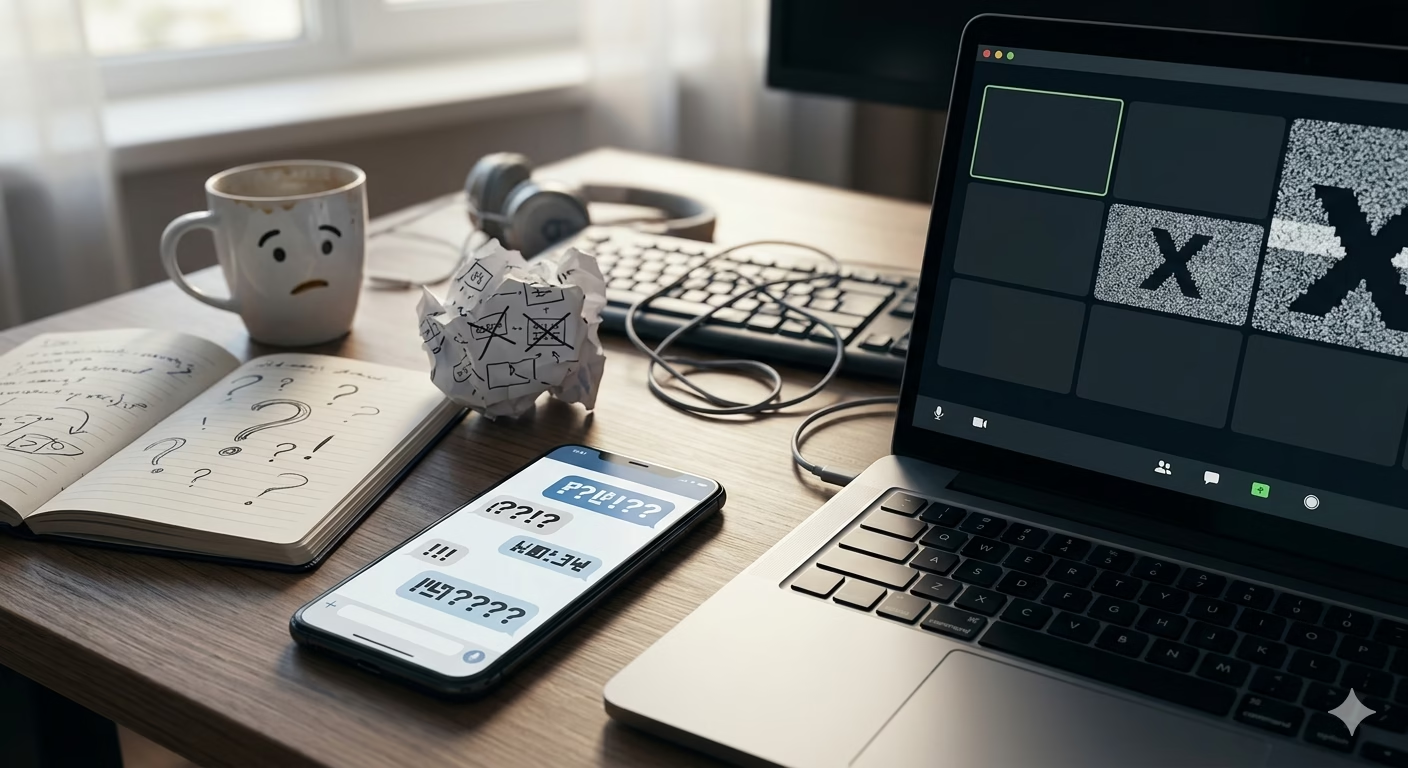
When your project manager writes in a Slack channel, you can’t see if they’re stressed or calm. You can’t hear the warmth in their voice or notice they’re smiling while delivering tough feedback. You’re left interpreting pixels, and interpretation becomes assumption. That’s where priority misalignment starts. A message marked with a deadline becomes an emergency in one person’s mind and a routine task in another’s. A question that should take five minutes gets interpreted as deep criticism. The emotional subtext that would be obvious in person becomes completely invisible.
Real-World Scenarios: How Digital Misinterpretation Derails Projects
Consider this common scenario. Your engineering lead sends this message to the design team: “Can we talk about the dashboard layout? Something doesn’t feel right.” In an office, this might be a casual chat between colleagues who respect each other’s work. In a remote environment, the design lead reads it as a fundamental problem with their work. Stress levels rise. The designer spends hours revising before the meeting, only to discover the engineering lead just wanted to discuss one button’s placement. The project loses hours to miscommunication.
Or imagine this: A team member responds to your urgent request with just “Ok.” In person, you might see them nod with understanding and immediately start working. Via text, you interpret this as passive resistance or lack of urgency. You send a follow-up message. They see the follow-up and think you don’t trust them. By the time the work actually gets done, both parties are frustrated and the psychological safety required for good collaboration has eroded.
These scenarios happen because remote communication lacks the layering of signals. Your tone can’t soften your words. Your facial expression can’t show you’re asking because you care about quality, not because you’re dissatisfied. Your energy can’t convey urgency without it seeming like panic. Teams end up with different understandings of the same priorities, leading to wasted effort, late deliverables, and damaged working relationships.
Establish Explicit Over-Communication Protocols
Over-communication sounds counterintuitive, but it’s actually the most direct way to compensate for missing non-verbal cues. You’re adding the context back in through words. This means being specific about priority levels, deadlines, and emotional intent. Instead of “We need this soon,” try “This is lower priority than the dashboard work. I’m hoping to have it by Friday, but Monday is fine too.”
Over-communication also means being deliberate about tone in writing. Research from the University of Chicago found that remote workers underestimate how their tone will be perceived 50% more often than in-person communicators (Kruger et al., 2005). You can compensate by adding context clues. For example: “I’m asking because I want to understand your thinking, not because I disagree” sets an entirely different tone than the same question asked flat.
Implement this by creating communication guidelines for your team. Specify that all project updates should include a priority level. All deadlines should include a buffer and what happens if the buffer is missed. All feedback should explicitly state whether it’s critical or optional. When team members know they’ll always receive this context, they stop filling in gaps with worst-case assumptions. This reduces the cognitive load of interpretation and keeps everyone aligned on actual priorities.
Leverage Asynchronous Video Updates for Context
Text is the default for remote communication because it’s fast and efficient. But it’s also the most ambiguous. Video doesn’t have to mean synchronous meetings. Asynchronous video updates are short, recorded messages that you send for people to watch on their own time. They restore crucial non-verbal cues without requiring everyone to be online simultaneously.
A two-minute video update where you explain a priority shift, deliver feedback, or clarify expectations carries your tone, your facial expressions, and your energy. Your team member sees you’re calm and collected, not stressed. They hear the warmth in your voice when you’re praising their work. They see the slight frown that indicates you’re thinking carefully, not that you’re upset. Companies using asynchronous video updates report a 23% improvement in message comprehension compared to text-only communication (Loom, 2023).
You can use tools like Loom, Vidyard, or even WhatsApp voice messages for this. When a Slack conversation gets confusing, instead of continuing to type, record a 90-second video explaining your point. When giving feedback on a major deliverable, send a video instead of a wall of text. Your team will understand not just what you’re saying, but why you’re saying it and how important it is.
Structure Feedback Loops with Clear Response Time Expectations
One of the biggest sources of priority misalignment in remote teams is unclear response expectations. Does no response within an hour mean they’re working on something important, or have they forgotten your message? Is a brief response disrespectful, or are they just busy? Are they avoiding the conversation, or do they genuinely need time to think?
You can eliminate this ambiguity by establishing explicit response time expectations. This isn’t about surveillance; it’s about transparency. You might establish: “Urgent requests in Slack get a response within 2 hours. Standard questions within 24 hours. Non-urgent feedback can wait up to 48 hours.” Everyone knows the baseline, so a 3-hour gap on an urgent request doesn’t trigger anxiety.
Structure formal feedback loops where people know to expect regular check-ins. Weekly 1-on-1s provide a dedicated space to recalibrate priorities face-to-face or via video. Project reviews every two weeks create moments where the whole team aligns on what’s urgent and what’s important. During these synchronous moments, you can restore face-to-face communication and catch misalignments before they become expensive problems.
Implement Status Indicators and Emoji Conventions
Your team’s digital body language needs visual signals. Status indicators on your communication platform tell people whether you’re available, in focus time, or offline. But you can go deeper with agreed-upon emoji conventions. Some teams use emoji to indicate urgency: a red circle for urgent, yellow for important but not urgent, green for routine. Others use emoji to add emotional context: a thinking face to show you’re considering something, a thumbs up to show genuine support rather than just compliance.
These small signals might seem trivial, but they provide the same function as facial expressions. When a teammate adds a thumbs up to your message with a slight delay, you see they took time to consider it. When they respond with a laughing emoji, you know they understand the light-hearted tone you were going for. When they flag something with a red circle, there’s no ambiguity about priority.
Set up conventions that your team agrees on and documents in your team handbook. Maybe a clock emoji means “I’ll get to this later today.” A clock with an arrow means “I can’t do this this week.” A green checkmark means “Done and I’m confident about it.” A clock with a question mark means “I’m not sure when I can do this; we should discuss.” These become your team’s shared visual language.
Building a Shared Digital Body Language Culture
The gap between remote communication and in-person communication won’t close completely, but you can build a culture that acknowledges this gap and compensates for it deliberately. This happens when teams treat digital body language as a legitimate competency and invest in developing it together.
Start by having a direct conversation about miscommunication in your team. Ask people about times they felt their message was misunderstood or when they misinterpreted someone else’s message. You’ll likely find that patterns emerge. Maybe your team tends to assume urgency when there isn’t any. Maybe they’re overly formal in writing. Maybe they struggle with giving feedback because they can’t use tone to soften it. Naming these patterns is the first step to changing them.
Then establish norms together rather than imposing them from above. When your team co-creates their digital body language guidelines, they own them. They might decide that Friday afternoon messages are always less urgent. They might establish that feedback is always invited on designs before the final draft. They might agree that any message longer than five lines should be a video. These feel less like rules and more like shared agreements.
When you build this culture intentionally, several things happen. First, your team’s cognitive load decreases. They spend less mental energy trying to interpret subtext. Second, psychological safety increases because people understand that miscommunication is a feature of remote work, not a personal failing. Third, priority alignment improves because the context is there to support accurate interpretation.
Starting Today: Three Concrete Actions
You don’t need to overhaul your entire communication system next week. Start with these three actions this week. First, send your team a message explaining this digital body language concept and ask them to reflect on a time they felt misaligned. This opens the conversation. Second, record a two-minute asynchronous video instead of writing your next important message. Notice how it changes understanding. Third, establish one simple emoji convention for your team’s most common communication platform.
These small steps begin building the shared language that keeps remote teams aligned. They cost almost nothing and they work immediately. From there, you can add more structure as needed. Maybe next week you establish response time expectations. The week after that, you document your team’s digital body language conventions. You’re building a system where missing non-verbal cues no longer means missing alignment.
Remote work is here to stay for most teams, and the teams that win are the ones that master communication across the distance. You can’t get back the 93% of communication that happens non-verbally in offices, but you can be intentional about replacing it with systems that provide equivalent context. Your projects will move faster. Your team will feel more understood. And you’ll spend less time untangling misalignments that shouldn’t have happened in the first place.
Share your biggest challenge with digital communication in your remote team. What miscommunication has derailed your priorities recently? The more teams talk about this openly, the faster we all get better at it together.