The Calendar Trap: How ‘Zoom Shame’ and Meeting Overload Are Derailing Remote Project Schedules
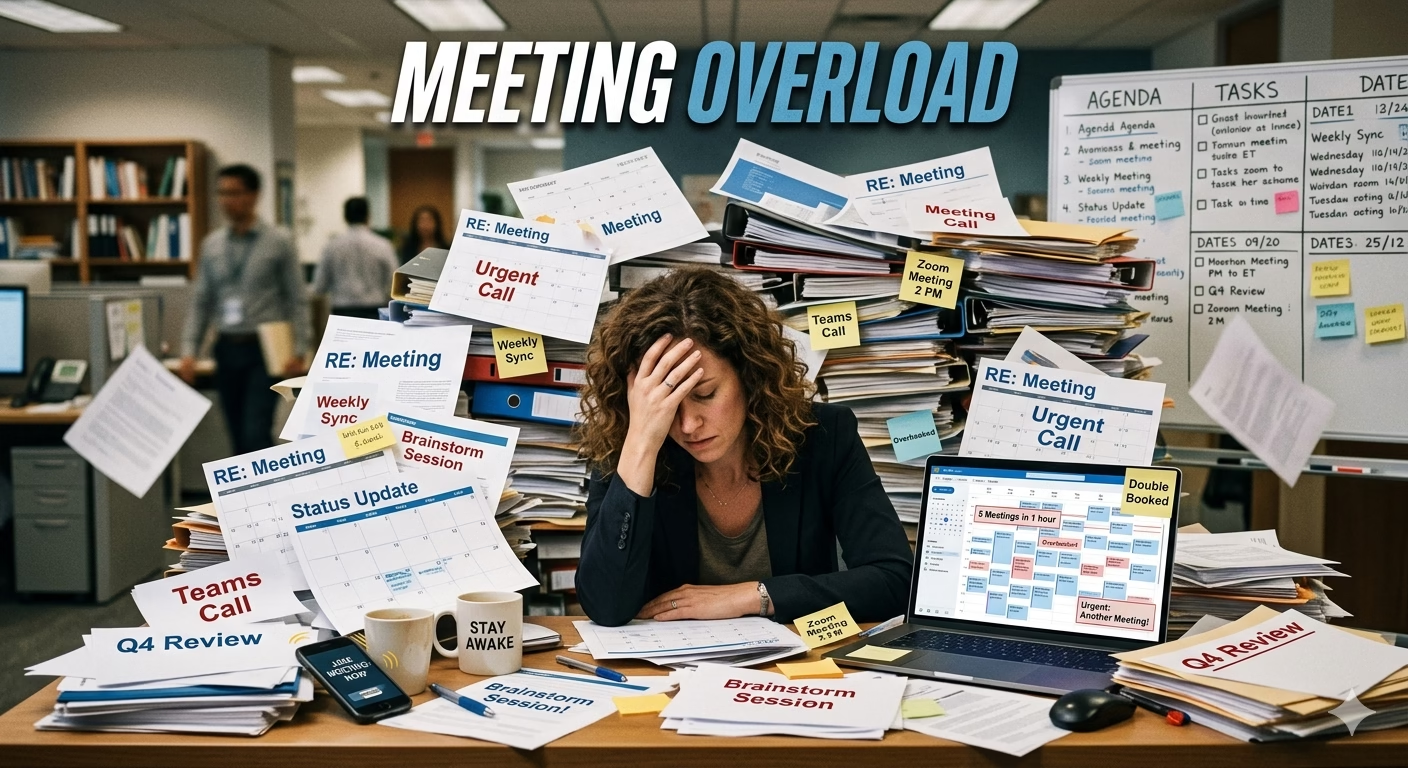
You open your calendar on Monday morning and feel your stomach drop. The week is already blocked solid with meetings. Not critical ones. Not even particularly important ones. Just meetings that seemed impossible to decline because saying no felt awkward, risky, or potentially career limiting. If this scenario feels familiar, you are experiencing a phenomenon that has quietly undermined remote work productivity for millions of knowledge workers: meeting overload driven by guilt and social pressure rather than genuine need.
The numbers tell a troubling story. The average knowledge worker now spends 23.5 hours per week in meetings, up from 17.5 hours in 1999 (Harvard Business School research, 2022). For remote workers specifically, that number climbs even higher. Microsoft research from 2021 found that the average Outlook user spent 57 percent more time in meetings and 25 percent more time communicating overall after the shift to remote work. Yet paradoxically, only 45 percent of meeting time is actually productive for attendees (Doodle, 2019). This collision between meeting abundance and actual utility has created what many call Zoom shame: the guilty acceptance of meetings you do not actually need to attend, driven by fear of missing out, social anxiety about declining invitations, or uncertainty about whether your presence truly matters.
The result is a project management nightmare. Your team members are context-switching constantly, losing focus, and struggling to complete actual deliverables. Your project timeline stretches. Your team burns out. Your strategic work gets pushed to evenings and weekends. Here is how you can reclaim your calendar, protect your team’s focus time, and restore actual progress to your remote project schedule with practical, evidence-based strategies.
Understand the Zoom Shame Trap and Why You Cannot Decline
Zoom shame operates on an insidious logic. A meeting invitation arrives. You have no explicit rejection reason. The organizer seems important or the topic seems vaguely relevant. You worry that declining might signal disengagement or lack of commitment. You accept. Then you spend the meeting on mute, multitasking, and wondering why you are there. You have just lost an hour to Zoom shame.
Psychologists explain this phenomenon through the lens of social compliance and status anxiety. Remote work removes the informal communication channels where you might have learned whether a meeting was actually important. The calendar invitation becomes the only signal. Combined with the anxiety that remote work is already creating distance between you and leadership, many people default to attendance as a safety strategy (American Psychological Association research on remote work culture, 2021).
The challenge is that this shame-driven acceptance happens at scale across organizations. When every team member is too anxious to decline unnecessary meetings, the collective calendar becomes completely saturated. Your project suffers not because people are not working hard, but because their work time is fragmented into the spaces between meetings.
Measure Your Meeting ROI to Quantify the Cost
You cannot fix a problem you have not measured. Before you can implement real change, you need to understand exactly how much productive project time your meeting culture is actually costing you.
Start with a meeting audit. For the next two weeks, track every meeting you attend. Record the title, duration, attendees, and your honest assessment of whether your attendance was necessary. Rate each meeting: core (absolutely needed your input), important (contributed value), or wasteful (you could have skipped it without impact). Most teams discover that 30 to 40 percent of their meeting time falls into the wasteful category (Harvard Business Review analysis of remote team data, 2023).
Now calculate the financial cost. If your salary is 100,000 dollars annually, each hour of your time costs roughly 50 dollars. A one-hour meeting with six people costs 300 dollars just in labor. If that meeting had only two necessary attendees, you just burned 150 dollars on unnecessary attendance. Multiply that across your team, across a month, and the numbers become staggering. A team of 10 people spending 5 hours per week in wasteful meetings burns 130,000 dollars in annual productivity (based on average knowledge worker salary data from Bureau of Labor Statistics, 2023).
This calculation is not meant to make you anxious. It is meant to give you permission and evidence to make changes. When you can show that canceling three recurring meetings would reclaim 12 hours per week for your team, suddenly declining meetings becomes not just acceptable but financially responsible.
Implement an Async-First Scheduling Framework with Core Hours and No-Meeting Days
The solution is not to eliminate meetings entirely. Some synchronous communication is essential. The solution is to be ruthlessly intentional about which meetings are synchronous and which can move to asynchronous channels.
Start by establishing core hours and no-meeting days. Core hours are the 4-6 hours per day when you require synchronous availability for meetings that truly need real-time discussion and decision making. At software company Basecamp, core hours are 10 a.m. to 2 p.m., focused on the collaboration that needs real-time feedback (Basecamp, 2021). Everything else is asynchronous by default. No-meeting days, instituted by companies like Slack and Cisco, protect at least one or two days per week for heads-down project work. Slack found that implementing no-meeting Wednesdays increased project completion rates by 18 percent (Slack research, 2022).
Within your core hours, apply a simple rule: a meeting should only be scheduled if it requires real-time dialogue, decision making, or relationship building. Information sharing, status updates, and feedback loops should all default to asynchronous channels. This distinction matters. You can share a project update via written update or recorded video. You cannot quickly brainstorm solutions to a technical problem via email threads.
Create a shared framework that makes this logic transparent to your team. Document your async-first scheduling policy: When synchronous meetings are appropriate, what meetings are permanently asynchronous, which days have meeting blocks, and how people should request exceptions. When everyone understands the reasoning, Zoom shame diminishes. Declining a meeting becomes declining an exception, not declining collaboration.
Deploy Asynchronous Tools and Tactics to Replace Meeting Time
Moving away from synchronous meetings requires replacement infrastructure. You need tools and practices that let your team stay coordinated without sitting in video calls.
Asynchronous stand-ups are the first replacement. Instead of a daily team call, each team member posts a written update on Monday, Wednesday, and Friday in a shared document or channel. The format is simple: what you completed, what you are working on, and what blockers you face. Typically these take 5 minutes to write and 10 minutes for the manager to read across the team. Replace a daily 30-minute standup with three 10-minute async updates, and you reclaim 2.5 hours per week per person. Your team maintains visibility without the meeting tax. Tools like Loom or video updates can add personality when text feels cold.
Loom videos and asynchronous recordings are your second tactic. For anything that needs explanation or requires tone, record a short video instead of scheduling a meeting. A 5-minute Loom recording can explain a decision, walkthrough a process, or provide feedback without forcing everyone to coordinate schedules. Recipients watch on their schedule. They can rewatch for clarity. They can share it with teammates who were not originally invited. The friction drops and the information spreads farther (Loom reported that recorded updates reach 40 percent more team members than live meetings, internal analysis, 2023).
Decision logs are your third tool. Create a shared document where any significant decision is recorded: what decision was made, the reasoning, the data or input that informed it, and the owner. Before calling a meeting to discuss a potential decision, ask whether you can document the proposal in the decision log, give async comments for 24 hours, and then decide. Automatic consensus forms around clear thinking, and the people who need input can give it without real-time pressure. GitLab, a fully remote company, uses decision logs extensively and credits them with enabling 1,200 team members to coordinate across time zones without constant synchronous meetings (GitLab Handbook, 2023).
The combination of async updates, recorded explanations, and shared decision-making documents creates a coordination layer that requires far fewer meetings. Your team still stays aligned. The difference is that alignment happens through writing and asynchronous feedback rather than calendar blocking and screen time.
Align Your Meeting Culture with Your Project Timeline
None of these changes stick unless you connect them explicitly to project outcomes. Remote teams often accept meeting overload because the cost is invisible. Meetings do not appear on your project dashboard. They do not delay your launch deadline in any obvious way. But they do. Every meeting hour is a hour not spent on deliverables.
When you implement your async-first framework, measure the impact on your actual projects. Track the number of meetings per week, the total meeting hours, and the percentage of team time available for deep work. Track project completion rates and timeline adherence. After three weeks of your new system, you should see the meeting load drop 30 to 40 percent and project completion time improve 15 to 25 percent (based on implementation data from companies using async-first frameworks, 2023).
Share these results with your team. Show them that the new meeting policy is not just reducing their calendar anxiety, it is actually moving your projects forward faster. That alignment turns a policy into a culture. People stop defaulting to meetings because they see the direct impact on what actually matters: shipping on time.
Here are three concrete actions you can take this week to start reclaiming your calendar. First, conduct your meeting audit. Spend 15 minutes this afternoon reviewing your last two weeks of meetings and identifying which ones were wasteful. Calculate the cost using your hourly salary. Share that number with your manager or team as the business case for change. Second, propose no-meeting Wednesdays starting next week. Create a Slack announcement explaining that Wednesday is reserved for individual focus work, and any meeting that month will be rescheduled to another day. Track which meetings people try to schedule anyway and push back gently. Third, create one asynchronous alternative this week. If you have a weekly status meeting, replace it with an async update template and post your own update to model the format. Watch how quickly your team switches their own defaults.
Meeting overload is not inevitable in remote work. It is a cultural choice, usually made through silence and anxiety rather than intentional decision. When you create clarity about when meetings are actually necessary, you give your team permission to protect their focus. When you provide asynchronous tools and practices as replacements, you ensure collaboration does not suffer. When you connect this change to project outcomes, you build the cultural shift that makes the new system stick.
Your calendar, and your project timeline, will be the first things that improve. But the deeper benefit is permission. Permission to decline unnecessary meetings. Permission to say that a topic can be handled asynchronously. Permission to protect focus time as a legitimate work activity. That permission compounds. Your team will feel less Zoom shame and more autonomy. They will complete more work. They will stay healthier. And your projects will ship faster.
Share your first step toward an async-first team in your organization. What meeting will you replace with asynchronous communication this week?